
Humphreys County Bench Warrants Explained
A bench warrant is a court response to a missed appearance, missed compliance duty, contempt, or another failure to follow an order. For a Humphreys County traffic or misdemeanor setting, start with General Sessions or the city court named on the paper. A family or child-support contempt process may belong with Chancery or Juvenile Court instead.
Do not assume that an unpaid amount instantly creates the same process in every court. The judge may use a notice, summons, show-cause order, bench warrant, or another entry. The clerk can tell you what the file says, but the issuing court decides whether to reset or recall its process.
Humphreys County Bench Warrant Missed-Date Routes
First identify the court that set the date. A Waverly citation goes to Waverly Municipal Court; New Johnsonville publishes a third-Friday schedule; McEwen's city site has no current court calendar or payment form. County misdemeanor and traffic settings generally route through General Sessions, while an indicted felony is a Circuit Court matter.
A clerk can distinguish a missed setting from a separate warrant entry. Ask whether the case is continued, in FTA status, subject to a bench process, or awaiting a judge. A call or payment does not itself recall an order unless the court confirms that it does.
Write down the name of the court and the date of the answer. A city citation should be checked with that city's clerk even when a county officer handled an earlier stop. Tennessee Safety may separately send an FTA or FTP notice about license compliance, but that notice is not the court's warrant record.
How Humphreys County Bench Warrants Are Issued
The judge or court acts after the missed obligation is brought before it. The process may direct an officer to take the person into custody, or the court may choose another response. The public sources do not publish a uniform grace period, notice sequence, code list, or countywide bench-warrant database.
Once issued, the responsible court controls the record and any recall. A city warrant may not be visible on the sheriff's website; a booking link does not search every court. Ask the clerk for the current status and the document or action that would change it.
The county and city sources publish no standard notice sequence, grace period, or waiting rule before a judge acts. Do not rely on an assumed number of days after a missed date. Ask whether the court has entered a process and what written instruction applies to that case.
Humphreys County Capias After Indictment
Tennessee Rule of Criminal Procedure 9 uses “capias or summons upon indictment or presentment.” A capias follows a grand-jury or related charging step. It is different from a lower-court failure-to-appear warrant, even though both can lead to an arrest and a bond decision.
For a felony or indictment question, the Circuit Court Clerk at 931-296-2461 is the court-file route; HCSO can address a custody or service question. No local capias number format, public lookup, or recall fee was located. Use the exact term the clerk gives you rather than assuming every process is an FTA.
The difference matters when asking for a record: a capias may be indexed under the indictment or felony case, while a missed municipal date stays with the city court. Give the clerk the indictment number, if available, and ask whether a public docket entry or return can be inspected.
Bench Warrants and Arrest Warrants Compared
A bench warrant responds to a court obligation that was missed. An arrest warrant follows a complaint or affidavit reviewed for probable cause. Both are issued through a court process, but the reason, file, and next action differ. The arrest-warrant process has a separate route and should not be confused with a city citation problem.
| Feature | Bench Warrant | Arrest Warrant |
|---|---|---|
| Trigger | Missed appearance or court duty | Complaint or affidavit showing probable cause |
| Who Issues It | The court handling the existing matter | Authorized judge or magistrate |
| Underlying Case | Usually an existing docket or citation | An alleged offense under investigation or charge |
| How It Clears | Court-directed reset, recall, or appearance | Court-directed surrender, bond, or appearance |
Humphreys County Bench Warrant Files in Chancery and General Sessions
General Sessions handles county traffic, misdemeanor, criminal, and civil work listed by the county. Chancery handles family, child-support, contempt, and related matters through the Clerk & Master at 931-296-2558. A Chancery contempt or attachment question should not be routed only to the criminal clerk or sheriff.
The county's Clerk & Master page identifies the records office at Room 202, 100 North Court Square. The screenshot below shows its public office information. Call before visiting because office-specific directions and hours can change.
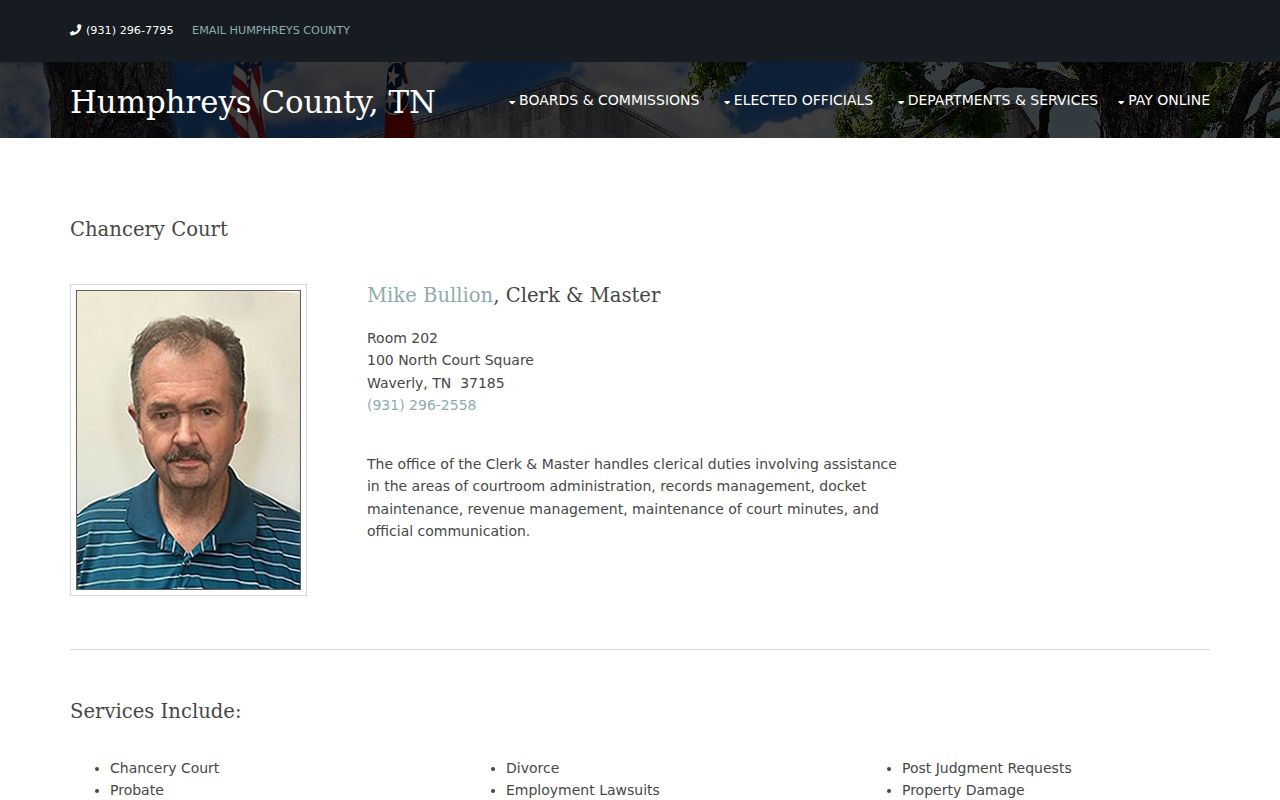
Ask which court issued the process and whether the clerk can provide a public docket status.
The Clerk and Master is at Room 202, 100 North Court Square, Waverly, while the Circuit and General Sessions Clerk is at Room 106 in the same building. A child-support or family contempt question should be routed by the court name on the notice; the courthouse address alone does not identify which office holds the case.
Resolving a Humphreys County Bench Warrant
Use the issuing court's directions, not a general online payment claim. The local sources do not publish a recall form, universal walk-in policy, bond schedule, or amnesty date. A lawyer may ask for a recall or reset; the judge decides the request. If surrender or bond is required, get the location, time, acceptable payment, and proof-of-resolution steps from the official office first.
- Call the clerk with the citation or case number and ask whether a bench warrant, capias, or other process is active.
- Ask what the judge requires: a motion, a new date, proof of payment, an appearance, or attorney-arranged surrender.
- Confirm any bond or payment terms with the court or HCSO using a published number.
- After action, get a receipt, court order, or written status confirmation.
Caution: Humphreys County sources publish no automatic expiration period; ask the issuing court for current status instead of waiting for an online list to change.
If an officer returned a warrant unserved or the court later entered a reset, ask whether that specific event changed the case status. A calendar entry, payment receipt, or verbal update may not substitute for the signed order or docket action the court relies on.
For traffic matters, a court may also report a separate FTA or FTP event to Tennessee Safety. The state notice addresses license compliance, not whether the judge recalled a bench process. Ask the issuing court whether it sent a correction or release and keep that proof apart from a payment receipt.
Humphreys County Bench Warrants Have No Automatic Expiration
The official Humphreys materials reviewed do not state that a bench warrant expires after a set number of days. A later payment or a new court date may not update every system at once. Ask whether the process remains active, was returned, or was recalled, and request the written order or receipt that proves the court's action.
No county amnesty or mass-recall event was located. If an event is later announced, verify its sponsoring court, dates, case types, exclusions, and proof process on an official page. Do not rely on an unsolicited call or a payment link that asks for gift cards or cryptocurrency.
Humphreys County Juvenile Warrant Records Are Restricted
A missed juvenile-court appearance or related process follows a different access path from an adult public docket. Tennessee Code § 37-1-153 protects juvenile court records, subject to statutory exceptions. Do not assume that a name search, an adult clerk counter, or a public-record request will disclose a juvenile file.
For a juvenile matter, contact the appropriate court through its official clerk channel and ask what information may be released to the person with legal authority to receive it. The clerk can explain the process without making a protected file public.
Section 37-1-153 contains statutory access exceptions, so confidentiality is not a promise that every document is withheld in every circumstance. The court must apply the exception to the file and the requester. Do not use an adult county search result to infer the status of a juvenile proceeding.
Finding the Court That Issued the Warrant
The court that set the case controls the bench process. Call General Sessions or the Circuit Court Clerk for county files, the Clerk & Master for Chancery matters, or the city clerk for a municipal citation. The sheriff can confirm service or custody routing, but does not replace the judge's recall decision.
For a possible arrest warrant, the Humphreys County warrant search route begins with HCSO at 931-296-2301 and the appropriate clerk. Give the court name, original date, and case or citation number, then ask what written proof will show that the process has changed.